You can always custom build your own custom course, Why not explore our building blocks library or book a consultation with our team
The human element
of change
Change and uncertainty are the background soundtrack / consistent elements within todays work environments.
Change, whether it’s a one-off initiative or ongoing requires a focused effort to prepare and land successfully.
#1
Change management effectiveness is now the top driver of employee engagement (Perceptyx, 2026)
74%
of HR leaders say their managers are not equipped to lead change (Gartner, 2024)
86%
of UK respondents cite core people-management skills as the #1 leadership priority (2026 L&D Impact Survey)
1 in 2
of HR leaders now rank change fatigue among the top five barriers to organisational success (Gallagher, 2025)
Navigating change in today's world
The ongoing ambient changes around market shifts, evolving technology, customer expectations and internal priorities, is something many experience day to day and forms how people work, collaborate and make decisions.
At the same time, organisations still encounter specific, one-off change initiatives system implementations, mergers, restructures, leadership transitions or strategic pivots - that require concentrated effort, clarity and coordinated human response.
These moments create acute pressure points where people need targeted support to understand what is happening, why it matters and the skills and strategies they and their teams need to successfully move through it.
Why change?
Organisations rarely change for the sake of it. The drivers are real and usually pressing: markets move, technology resets what is possible, customer expectations rise, or the cost base stops working. The cost of not changing is rarely dramatic at first. It shows up as erosion. Talent leaves for organisations that feel like they are going somewhere. Customers don't complain, they just don't come back. By the time the need is obvious, the options have narrowed and the change that follows is bigger and more painful than it needed to be.
So the reason almost always exists. The problem is what happens to it. It is clear to the people who set the strategy and much less clear to everyone asked to deliver it. The conversation becomes dominated by how: which model, which milestones, which communications plan. The why is treated as self-evident, or covered once at launch and never returned to.
When change is constant, that no longer holds. Why becomes the harder question, and the one that determines whether anything actually shifts.
- Why this change?
- Why now?
- Why does it matter to the organisation, my team, and me?
Where change fatigue has set in, people are rarely resistant because they don't understand the process. They are unconvinced by the purpose. Starting with why also changes what we ask of leaders. Their first task is not to roll out a plan. It is to make meaning - a narrative that is honest about what is uncertain and clear about what is not.
Change is a human process
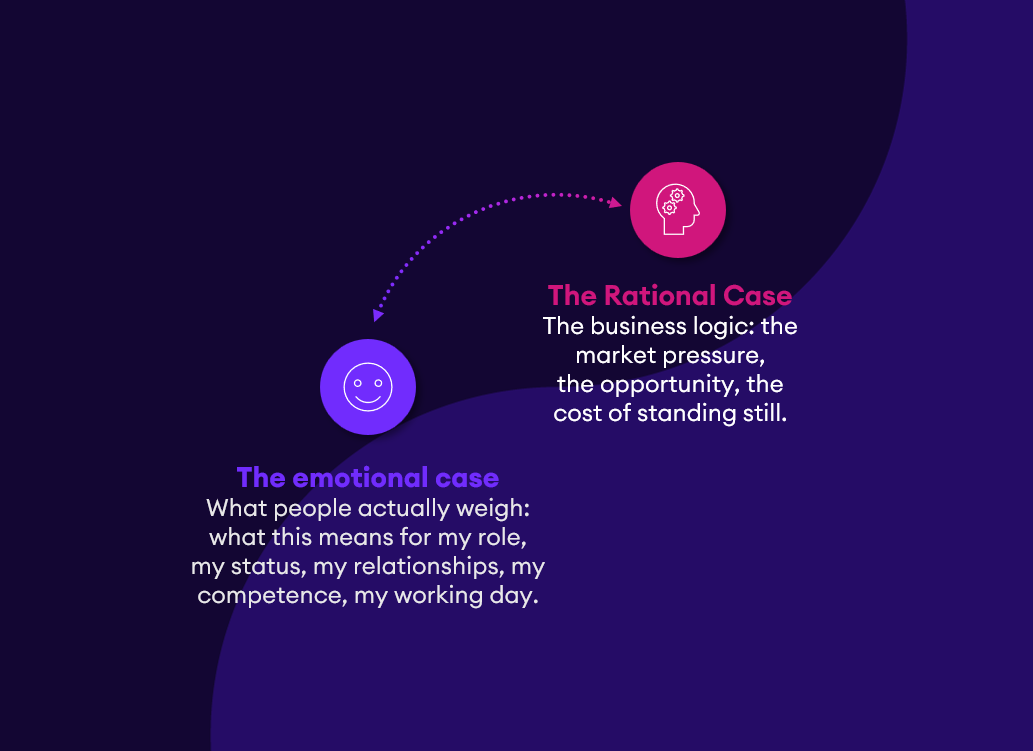
We start from a straightforward position. Organisational change succeeds or fails on human terms. Structures, systems and plans are all necessary, but they only move when people move them. Change efforts that make only the rational case tend to secure compliance. Those that make both earn commitment.
That leads to two principles:
1. Across the full span of people
From the individual living the change to the leader guiding others through it.
Before the change, during it, and long after it has landed.
How individuals navigate change
Whether it is the ongoing background reality or a specific initiative, change brings emotional, cognitive and behavioural challenges.
In continuous change, people have to sustain resilience and keep momentum over long periods.
In one-off change events, they face spikes of uncertainty, rapid transitions and the need to recalibrate roles or responsibilities.
Where people struggle, it is often because they lack the tools and language to make sense of what is happening — and because the reason for the change has never been made clear enough to hold on to.
How leaders guide and stabilise others
For leaders, the demands are the same whatever the change. They must communicate openly, pace change appropriately, and create the psychological safety for teams to raise concerns, test new approaches and move forward with confidence. What differs is how those demands play out.
Communication in continuous change is consistent and low-key, keeping people connected to why the work matters; in a specific change event it becomes a clear narrative, repeated often and honest about what is still unknown. Role modelling day to day means absorbing constant small shifts without passing the churn on to the team, while in a defined change it looks like visible steadiness when everyone else is unsettled.
Our brand new workshops
Six new topics for before the change, during the hard middle, and after - as ready-to-run sessions or the foundation for something built around you.

Inspiring individuals through change
Two sessions that give people the language to make sense of what's happening and the habits to stay steady while it does.

Equipping leaders ready for change
Four sessions covering both kinds of change a manager faces - the restructure with a date on it, and the constant churn that never announces itself.

Making sure change actually sticks
Build something custom from these modules and the wider library, designed with our instructional designers around the change your organisation is facing right now.
Human skills as change enablers
The capabilities that carry people through change are human capabilities. Resilience, emotional intelligence, communication, psychological safety, collaboration, growth mindset - these are not soft accompaniments to the real work of change. They are the mechanism by which change actually happens.
Built before — human skills developed ahead of a change create genuine readiness.
Applied during — they keep people clear-headed and connected under pressure.
Practised after — they turn a completed initiative into a lasting shift, and into capacity for what comes next.
They can't be treated as generic. The empathy a leader needs when announcing a restructure isn't the empathy needed six months in. They're best developed in the context of change, at the point they're needed.
Where change support
goes wrong
Most change support clusters around the launch. Yet readiness is built long before the announcement, and value is only realised long after it. Each of the three phases asks something different — and two of them are routinely unfunded.
The consequence isn't just a weaker outcome on this change. It's a weaker starting position for the next one. Without a proper close, organisations repeat the same change badly, and people carry the residue of the last one into the next.
"The landscape and business is transforming faster than we can reskill."
— UK respondent, 2026 L&D Impact Survey
Support arrives at the wrong time
Readiness gets a briefing and closure gets forgotten. Nearly all the investment lands between announcement and go-live - the hardest phase to rescue if the first was skipped.
Only half the case gets made
The rational case is in the deck: market pressure, opportunity, the cost of standing still. The emotional case - what this means for my role, my status, my competence, my working day - is rarely made at all.
Managers are briefed, not prepared
They're asked to explain decisions they didn't make, absorb heightened emotions, and provide direction while the path is still emerging. Being told about a change isn't the same as being ready to lead others through it.
The last change was never closed out
When an initiative simply stops being mentioned, people draw their own conclusions. The next one then starts from a deficit, against an audience that has learned not to invest.
Change we've helped land
Every organisation's change looks different from the inside, and the diagnosis is rarely the one written in the brief. Sometimes what looks like a technical capability gap turns out to be a trust problem. Sometimes the challenge isn't the change itself but whether managers across four countries can be relied on to handle it the same way.
What these three have in common is that the human side was treated as the work rather than the wrapper. And in each case, the impact was measured against something - a like-for-like assessment, a business outcome, a behaviour observed by someone other than the participant.

The situation
They came to us partway through building a technical development track. The goal was digital transformation, so technical capability looked like the answer.
What we found
Working through it together, a different diagnosis emerged. What was missing were leaders who reached across business units and built enough trust that difficult conversations happened in time to matter. So we set the original track aside and started again.
What we built
Four months per cohort, blending virtual workshops, peer coaching and a live feedback loop — applied to real deals rather than classroom cases.
The impact
+23% growth in leaders' confidence to drive innovation, the weakest behaviour going in · 198 new behaviours observed by colleagues and clients · 2 deals won and credited to those behaviours · 4.5/5 average score, with 93% rating it 4 or 5
The situation
An industry where regulation is absolute, safety margins aren't negotiable and decisions play out over decades. Rapid sector growth meant new people, new expectations and a sharply increased need for confident leadership - across four countries and five sites.
What we built
People Manager Essentials, structured around three themes in sequence: Leading Me. Leading We. Leading the Organisation. Designed from focus groups in every region, delivered by local facilitators in native languages, with cohorts deliberately mixed across sites and levels.
The impact
93–97% attendance sustained across all six workshops · NPS of 76.23 across 793 respondents · every one of 24 behavioural indicators improved twelve weeks after completion · skill ratings below competent went from 16% to zero
Worth noting
Partway through delivery their UK head office moved premises. Rather than work around the disruption, the facilitators used it — applying the change models from the programme to a transition the team was actually living through.
The situation
Leaders promoted for technical expertise, now responsible for people, across Europe, Asia and North America. A common pattern and a costly one: technically capable managers who haven't been equipped for the human part of the job.
What we built
A scalable hybrid programme shifting leaders from technical specialists to confident, people-centred leaders - designed to work at scale without losing the practice and reflection that changes behaviour.
The impact
90% better equipped for change · 84% increase in leadership confidence · three in four applying their learning on the job
Facing change in your organisation?
We help organisations build the human capability that decides whether change actually happens - from the individual living it to the leader guiding others through it. At any scale, in 90 countries and 70 languages, with impact measures agreed before we build anything.
Download our latest insight paper
Every organisation's change looks different from the inside. A restructure that's technically done but hasn't landed. A rollout people are working around rather than with. Growth outpacing the managers absorbing it.
The human element of change: key questions answered
Most change initiatives fail on human factors rather than planning. The plan is usually sound; what's missing is a convincing answer to why, managers equipped to carry the message, and support before the launch or after go-live. Where change fatigue has set in, people are rarely resistant because they don't understand the process — they're unconvinced by the purpose. Research published in 2026 found that perceptions of how change is handled have declined for two consecutive years, even as change management effectiveness became the single strongest predictor of employee engagement.
Change fatigue is the exhaustion and disengagement people feel after repeated organisational change, particularly where previous changes were poorly closed out or didn't deliver what was promised. It shows up as compliance without engagement rather than open resistance, so more communication rarely fixes it. Notably, change fatigue doesn't discriminate between positive and negative change — even changes people support deplete their capacity to absorb the next initiative. Addressing it starts with closing out the last change honestly, reducing the concurrent load, and building human capability before the next one lands rather than during it.
Communicating through uncertainty, making the case for change, holding difficult conversations, coaching under pressure, building psychological safety, working with resistance rather than overriding it, and pacing change appropriately. In the 2026 Hemsley Fraser L&D Impact Survey, 86% of UK respondents named core people-management skills as their top leadership priority for the next 12 to 18 months. A 2024 Gartner survey of 473 HR leaders found 74% said their managers were not equipped to lead change.
All three, and the first and last are the ones most often skipped. Before builds capacity: understanding personal responses to change, strengthening resilience in advance of need, helping leaders anticipate reactions rather than react to them. During sustains performance through the ambiguous stretch where the old way has gone and the new way isn't established. After consolidates new behaviours into habits and captures what should carry forward - without it, organisations repeat the same change badly.