You can always custom build your own custom course, Why not explore our building blocks library or book a consultation with our team
Insight paper
Boosting human skills to succeed in an AI world
As humans, we need to power up key capabilities and connections – now more than ever.
Technology, including AI automation and augmentation, is already reshaping how organisations get work done. Business leaders need to prepare their workforce for major changes and disruptions in the nature of work – what it is, how it’s done, the skills and capabilities needed.
Boosting human skills and capabilities is more important, not less – social-creative and interpersonal abilities are crucial for thriving in an AI world, and for tackling increasingly complex problems.
When we are connected to each other, a wider purpose, and ourselves we are better able to navigate the inherently uncertain world we occupy. To thrive, we need to be even more human.
1. What are ‘human skills and capabilities’?
Human capabilities are what makes us unique - how we are, how we think, how we relate to each other.
Human skills and capabilities are extraordinary. They help us be at our best in many different contexts, and are not specific to any particular job or organisation. They can be valuable outside of work too! We consider ‘soft skills’ to be a subset of human skills.
In comparison, technical skills are job-specific knowledge and capabilities. They tend to focus on knowledge and expertise, enabling employees to perform core tasks and meet the performance requirements associated with a particular role and / organisation. Examples might be programming, engineering, accounting.
Whilst human skills and technical skills are both important in the workplace, they serve a different purpose and are often developed in different ways.
What’s the difference between skills and capabilities?
Skills are the building blocks, which combine into higher order capabilities. For example, rapport building, active listening, and summarising are three of the skills which combine to help develop a coaching capability.
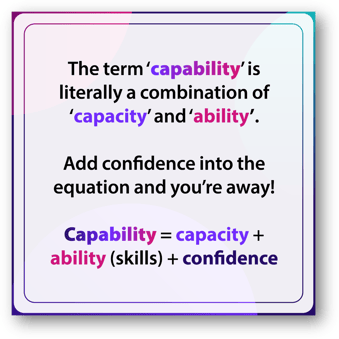
To build and sustain capability you need enough of all three. Learning to drive is a capability and requires plenty of capacity (time and thinking space) especially at the start to build your many skills and confidence safely.
Capabilities only come to life when you use them, practice and refine them. Reading an article about presenting doesn’t mean you are a skilled presenter. It takes time and space as well as the opportunity to learn from practice, experience, and progress.
2. What are the top 12 human skills and capabilities?
As humans, we have the unique ability to think like humans, connect like humans, and meet our human needs – but what are the specific skills and capabilities we really need?
The Hemsley Insights Group (a team of external L&D practitioners, clients, and internal learning experts) reviewed the latest evidence from research and L&D best practice and identified our top 12 human capabilities with 3-4 key skills associated with each.
Our framework deliberately covers four perspectives which together form the human experience in organisations – represented in the four columns below.
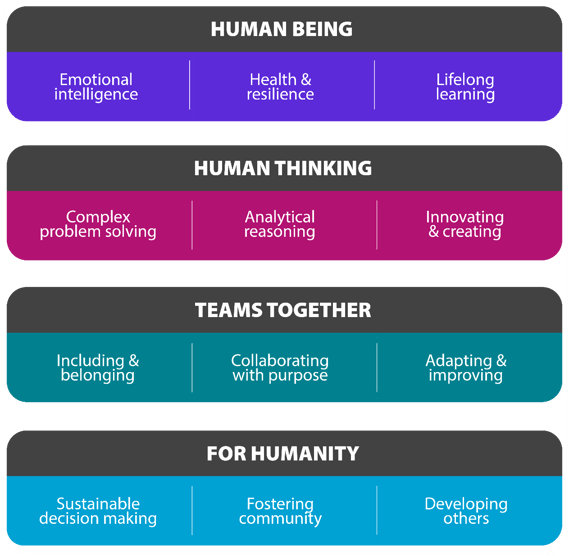
Moving from left to right, the scope of capabilities expands – from being primarily individually focused to a much bigger and broader agenda.
Many may seem familiar to us as humans, but the AI context is making them even more important. Also, they can change as technologies develop, so we need to evolve our understanding and approaches continually. For example, analytical reasoning in an AI context is becoming less about processing and more about problem defining, prompting, reviewing and critiquing.
We believe everyone needs to boost their ‘human capabilities’ but there may be particular priorities for an organisation at any point in time
Like any capabilities, you can build capability at individual, team and organisational levels. Leaders and L&D teams can make learning and development solutions available for individuals, for teams to learn together, for certain populations (e.g. senior leaders) or for everyone (through a learning campaign / theme).
So we’ve discovered what human skills and capabilities we most need, but what about how we develop them?
3. Seven factors to optimise ‘human learning’ – our RESPECT model
To boost human skills and capabilities it is vital we attend to how we design and provide the best learning – we need to respect how humans learn best.
In our experience, humans learn best when these seven factors are in place.
|
Our RESPECT model provides a helpful checklist to boost human learning |
|
|
Rhythm |
As adults, we learn best when it is relevant, integrated in the rhythm of work, and valued by the organisation. Ensure learning is well-timed - it can be tempting to train new managers months ahead but they acquire skills best when they have real experiences to address. Ensure it fits well in the organisational rhythm, easing the path for all involved. |
|
Emotions |
Learning is an emotional business, but is usually ignored in the design of learning solutions. Humans retain knowledge best when it’s also connected to a mildly positive emotion / memory of one. Additionally, strong emotions are contagious (such as courage or anxiety). Human learning design needs to attend to the emotional experience too. |
|
Social connection |
Humans are neurologically wired for connection, and hormonally rewarded for successful connections. Being together physically doesn’t guarantee connectedness any more than virtual, in fact it can sometimes get in the way. If events help build meaningful connections, learning and wellbeing can be boosted too. |
|
Psychological safety |
Learning can involve risk - we need to stretch beyond our comfort zones, be able to get involved, and be ready to speak up. Take time to establish a safe environment and a sense of belonging and inclusion – it’s OK and right for me to be here, now, with these people. |
|
Engaging design |
Learning needs to engaging by design. Excite learners so they feel open, present, intrigued – not distracted, overwhelmed, judged. Engage them with methods that blend together providing for accessibility, different preferences, and greater impact. Embed learning real through on-the-job reinforcement, practice, peer support. Evolve solutions as the contexts and learners do. |
|
Continuing |
Human learning is rarely one and done. The half-life of skills is now estimated to be 5 years or less. Also ‘mastery’ is part of the human condition, good for our mental and cognitive health. Our brains can retain plasticity through our whole lives - we need to keep using them, having new experiences, and building fresh connections. |
|
Time |
The #1 challenge for L&D uptake is “not enough time”. Learning events can be a welcome oasis in the busyness of work, but humans really do need time and space to learn, retain and practice new capabilities, especially at the start. Sleep also helps so try and avoid cramming everything into one day if possible. |
4. Examples of how organisations are responding to the challenge
In-team activities : Engaging activities for teams to learn together in a team meeting.
- Fits into the existing team meeting rhythm
- Engaging and participative design
- Flexible location (on site / online)
- Conversation based, antidote to digital
- Pick of topics – to ensure relevance
A calendar of events through the year with one focus topic per month.
- Likely to be 10 topics / themes over the year
- Pick topics that matter for your organisation
- A flow of learning events throughout the year
- Multiple activities each month (e.g. for individuals / teams / leaders) targeting a capability
On demand programmes: Off the shelf or bespoke program, single or multiple topics.
- For an existing team or a mixed group.
- Extensive range of topics to choose from, aligned to our human skills.
- One off or a collection of modules
- Blended design with digital content plus face to face or virtual options available
Here are a few examples of learning solutions we have partnered with client organisations to develop – for inspiration. They typically focus on a critical human skill / capability and are designed in ways that reflect our RESPECT model.
Boosting human skills and capabilities is becoming more important, not less. When we are connected to each other, a wider purpose, and ourselves we are better able to navigate the inherently uncertain world we occupy. Technology and AI can do a lot, but we will always be best at being human.