The more AI can do, the more human you need to be.

Human skills development
for the AI era

Hemsley Fraser is an enterprise partner for leadership and human performance transformation. We help organisations build the human skills that technology cannot replace, using our Excite, Engage, Embed, Evolve methodology to drive lasting behaviour change across leadership, communication, resilience, emotional intelligence and critical thinking 

We believe human skills aren't a 'nice to have'. They're the foundation of everything we do.

Human first development

What are human skills?

Human skills are the capabilities that make us uniquely human - how we think, how we relate to others, and how we show up in the world. They include emotional intelligence, complex problem solving, creativity, collaboration, resilience, and leadership.

Unlike technical skills, human skills aren't tied to a specific role or tool. They're transferable, durable, and increasingly critical in a world where AI is reshaping how work gets done.

At Hemsley Fraser, we identify 12 core human capabilities - grouped across four dimensions of the human experience.

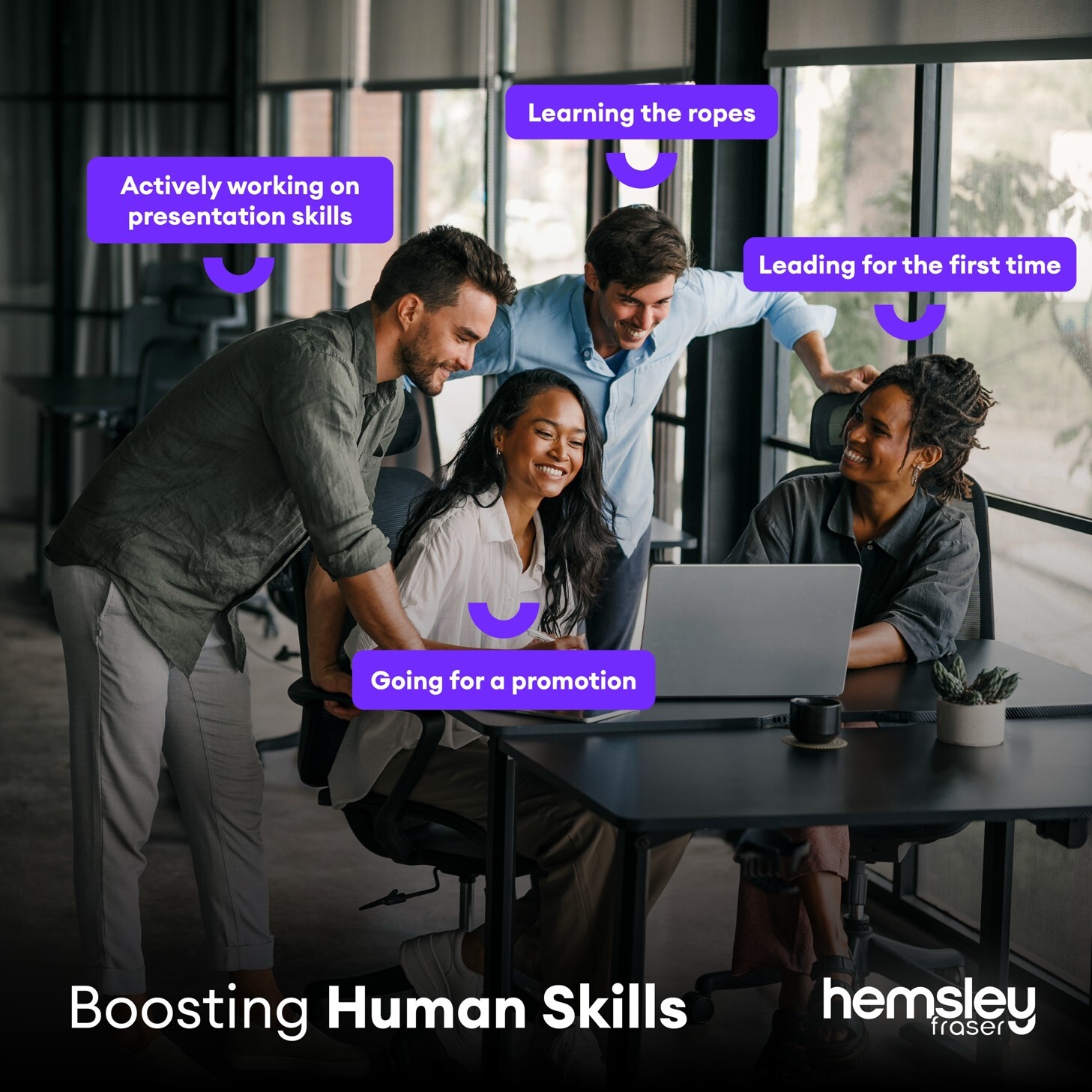
Two colleagues collaborating whilse on a laptop — human skills development at Hemsley Fraser

86%

 of UK organisations cite people management skills as their top leadership priority

(L&D Impact Survey, 2026)

91%

of L&D professionals agree human skills are increasingly important.

(LinkedIn Workplace Learning Report, 2025)

92%

of hiring managers say candidates with strong human skills are becoming more important.

(LinkedIn, 2025)

How we help you build human skills & capabilities

We've partnered with some of the world's most recognised organisations - including Shell, Barclays, BAE Systems and Coca-Cola Europacific Partners - to develop better leaders, stronger teams, and the human skills that drive lasting results

For organisations needing to build human skills consistently across multiple regions, see how we deliver globally 

Looking for something ready to go?
Browse 100+ expert-led courses across every human skill, available in-person, virtual, or blended. 

Need something more tailored?
We'll design and build a custom programme around your culture, your challenges, and your people.
Top_20_Leadership_2026
The 12 human capabilities

Our framework for what matters most.

Our Hemsley Insights Group - a team of external L&D practitioners, clients, and internal learning experts — reviewed the latest research and identified 12 core human capabilities across four dimensions of the human experience.

Boosting human skills and capabilities is more important, not less – social-creative and interpersonal abilities are crucial for thriving in an AI world, and for tackling increasingly complex problems. 

When we are connected to each other, a wider purpose, and ourselves we are better able to navigate the inherently uncertain world we occupy. To thrive, we need to be even more human. 

Human being

Emotional intelligence · Health & resilience · Lifelong learning

Human thinking

Complex problem solving · Analytical reasoning · Innovating & creating

Teams together

Including & belonging · Collaborating with purpose · Adapting & improving

For humanity

Sustainable decision making · Fostering community · Developing others

How we design human skills learning that actually sticks 

Knowing which human skills matter is only half the challenge. Building them in a way that genuinely changes behaviour is the harder part. Our RESPECT model identifies seven factors that determine whether human skills learning works, grounded in evidence about how adults learn best.

Rhythm
Adults learn best when learning fits the rhythm of real work. Timing matters more than most organisations realise. Training people in skills they cannot immediately apply rarely sticks. We design programmes to be relevant in the moment, not six months before or after the challenge arrives.

Emotions
Learning is an emotional process. Humans retain knowledge best when it is connected to a positive emotion or a meaningful memory. We attend to the emotional experience of learning, not just the content, because that is what determines whether new behaviours are adopted or discarded.

Social Connection
Humans are neurologically wired for connection. When learning builds meaningful human connections alongside capability, both learning and wellbeing improve. We design experiences that foster genuine connection rather than just co-presence in a room or on a call.

Psychological Safety
Learning requires stepping outside comfort zones. Participants need to feel safe to speak up, try new things and make mistakes without judgement. We build psychological safety deliberately into every programme we design, because without it even the best content will not produce behaviour change.

Engaging Design
Learning needs to be engaging by design. We use our Excite, Engage, Embed, Evolve methodology to design experiences that are accessible, relevant to different learning preferences and built for greater impact. Engagement is not entertainment. It is the condition that makes application possible.

Continuing
Human learning is rarely one and done. The half-life of skills is now estimated at five years or less. We design learning as an ongoing journey, with reinforcement, application activities and regular practice built in, so new capabilities compound over time rather than fade after a single event.

Time
The number one barrier to L&D uptake is not enough time. We respect this reality. Our programmes are designed to fit into busy working lives, using a blend of formats and durations that remove the friction between wanting to develop and actually doing it.

Human skills & personal development

Browse our library

Whether you need ready-to-go courses, a custom-built programme, or bespoke learning content designed around your culture — we've got you covered. From a single workshop to a global learning journey, we build human skills solutions that actually stick.

The power of human connectedness in an uncertain world

The level of uncertainty experienced over the past three years is unprecedented, bringing far-reaching implications for individuals, teams and organisations. We find ourselves having to cope with complexities including new ways of working (including hybrid), shifting expectations, automation, increasing use of AI, economic challenges, and health concerns.

Are your learners' time poor?

We keep hearing how a ‘lack of time’ is impacting employee’s engagement with learning – but is that really the whole story and what are the best organisations doing to tackle this important and growing issue.

Many feel busier now than ever before. Research suggests there are a combination of factors at play - including increased work demands, information overload, changing lifestyles, societal, psychological and cultural shifts. Multiple competing obligations and expectations can be draining and makes you feel a lack of choice and control. Time hasn’t reduced, but it certainly feels like it has sometimes! 

Ready to get started?

We love to talk. Tell us more about your context, goals and requirements. We’ll be delighted to help.


To book a public scheduled course: Please book online or call us to discuss options.

To enquire about bringing a course in-house: Please complete the contact form or call us.

Training Industry Webinar

Many teams now have access to artificial intelligence (AI) tools but still struggle when priorities shift, decisions get messy or work doesn’t follow a script. Drawing on Hemsley’s research, this webinar introduces a set of 12 core human capabilities that consistently underpin effective performance alongside AI, including how people make judgements, interact with others, respond under pressure and adapt in real situations.

?rel=0" title="YouTube video player" frameborder="0" allow="accelerometer; autoplay; clipboard-write; encrypted-media; gyroscope; picture-in-picture" allowfullscreen>

Your human skills questions, answered.

In a world moving faster than ever, it's easy to focus on the next tool, platform or AI solution. But the organisations pulling ahead? They're doubling down on their people. Human skills — emotional intelligence, critical thinking, collaboration, resilience — are what turn good teams into great ones. They can't be automated. They can't be downloaded. And right now, they matter more than ever.


Human skills are the capabilities that make us uniquely human — how we think, connect, communicate, and lead. They include emotional intelligence, creative thinking, complex problem solving, collaboration, resilience, and the ability to develop others. Unlike technical skills, human skills are transferable across roles and industries and cannot be replicated by AI or automation. At Hemsley Fraser, we identify 12 core human capabilities across four dimensions: Human Being, Human Thinking, Teams Together, and For Humanity.


{