You can always custom build your own custom course, Why not explore our building blocks library or book a consultation with our team
Time-Poor Learners: Why “Lack of Time” Is a Strategic Learning Issue
We keep hearing how a “lack of time” is impacting employees’ engagement with learning.
But is that really the whole story?
And what are the best organisations doing differently to tackle what is clearly a growing and important issue?
This insight explores what’s really going on behind time-pressured learning — and why responding effectively requires a strategic, coherent approach rather than isolated fixes.

It’s time to get strategic about time-pressured learning
Lack of time is the number one reason employees say they are held back from learning.
Whether people are actually busier now (or not) misses the point.
People feel time-poor. They believe they are under pressure. And they know it won’t get better on its own.
At the same time, continual learning has never been more important.
The half-life of skills is now less than five years, creating both short- and long-term skills gaps.
So learning matters more than ever — yet it’s often the first thing to fall away when pressure increases.
This isn’t something individuals can fix on their own.
‘Busyness’ is a cultural and leadership issue.
Increasing time pressure — what’s really going on?
Many people feel busier now than ever before.
Research suggests this sense of pressure is driven by a combination of factors, including:
- Increased work demands
- Information overload
- Changing lifestyles
- Societal, psychological, and cultural shifts
Multiple competing obligations drain energy and reduce people’s sense of choice and control.
Time hasn’t reduced — but it often feels like it has.
Time poverty and burnout are closely intertwined, both stemming from an imbalance between demand and resources. Burnout doesn’t happen overnight, but its effects can be far-reaching, impacting performance, wellbeing, and learning capacity.
Understanding what’s driving this pressure is the first step toward addressing it.
The data behind the pressure
The scale of the issue is hard to ignore:
- 77% of employees have experienced burnout
- 70% of executives have considered leaving their roles due to stress
- Workers spend, on average, 28% of their week on emails and 35% in meetings
- 88% of executives cite workload pressure as a top challenge
- 45% of workers report their workload has significantly increased
This reinforces an important point:
Whether people are truly busier now misses the point — people feel it, believe it, and experience its impact every day.
Why busyness is so hard to escape
Busyness isn’t just about workload.
It’s reinforced by powerful social and psychological forces.
These include:
- Society glorifying busyness as a sign of success or importance
- The dopamine hit that comes from completing tasks
- Fear of missing out, leading to over-commitment
- Difficulty setting boundaries or saying no
- Denial of personal limits
- Habitual patterns that become hard to break
- A “hero” mindset, where overworking feels virtuous or necessary
Over time, busyness becomes self-reinforcing — making it increasingly difficult for individuals to step back, reflect, or make space for learning.
This is why simple time-management tools aren’t the answer.
People are motivated to learn — even when time is tight
While lack of time is the top reason employees give for missing out on learning, many people are still learning — often in their own time.
Across generations, the strongest motivations remain consistent:
- Personal growth and self-improvement
- Increasing earning potential
- Personal interest and curiosity
- Enjoyment in learning something new
- Staying competitive in their role or industry
Younger generations, in particular, increasingly see learning as essential to career progression.
So motivation isn’t the issue.
The real question is whether organisations are creating the conditions that allow learning to happen sustainably, effectively, and during work — not despite it.
Learning is a critical business issue
Whether or not your people are learning is no longer a “nice to have”.
It’s a critical business issue — one that requires a strategic, innovative, and coherent response.
Addressing time-pressured learning successfully means tackling three interacting aspects in parallel. Focusing on just one risks wasting even more time and effort.
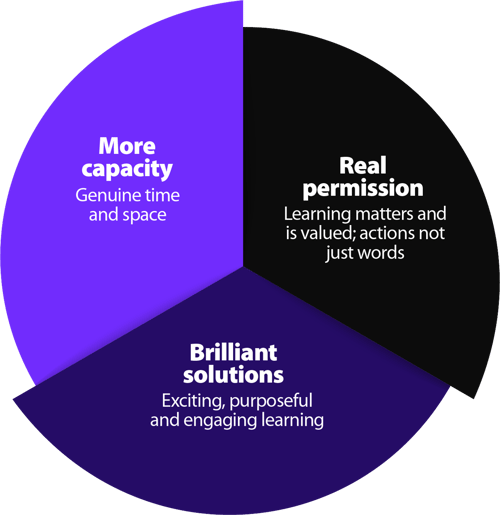
Creating more capacity — time and space to learn
Constant distraction is one of the biggest drains on time and attention.
Research shows workers now switch between apps and websites hundreds of times a day, leaving little space for deep thinking, creativity, or learning.
To counter this, organisations are experimenting with approaches such as:
- Taking people “off the clock” for protected learning time
- Designing short, focused learning that fits naturally into work cycles
- Providing learning exactly when it’s needed, not weeks in advance
- Actively limiting distractions and encouraging deep work
“We must never become too busy sawing to take time to sharpen the saw.”
Creating capacity isn’t about adding more to people’s plates — it’s about removing low-value work and making learning possible.
Giving real permission — showing learning is truly valued
Permission and approval are powerful forces in organisations.
Leaders and managers set the tone for what is acceptable, expected, and valued. What they pay attention to matters more than what they say.
When leaders visibly prioritise learning, it sends a clear signal that development is not optional or indulgent — it’s essential.
Effective approaches include:
- Leaders openly sharing their own learning
- Regularly asking teams what they’ve learned
- Linking learning to career progression and leadership expectations
- Aligning learning investment with strategic business priorities
Leaders who act as learners — not just knowers — help create environments that support growth, experimentation, and healthy striving.
Crafting learning solutions that earn people’s time
If people start learning activities but don’t complete them, it’s a warning sign.
Unfortunately, there is a lot of poorly designed learning that competes for attention without delivering value.
To achieve real behavioural change, learning must be:
- Relevant and meaningful
- Designed with attention and cognitive load in mind
- Clearly connected to real work challenges
- Engaging enough to sustai