You can always custom build your own custom course, Why not explore our building blocks library or book a consultation with our team
When we consider the world of learning, there has been a huge swing from in person to digital and virtual learning since the pandemic, and this has largely remained in place despite the new normal of hybrid working.
In this paper, we propose that the time is right to ‘reimagine’ how we use in-person learning as part of a blended learning experience. Intentionally combining modalities at different stages, using each for what it does best, with in person experiences elevating the moments that most need shared energy, collaboration and connection.
Rebalancing how and where we use
in-person as part of blended experiences is not a step backwards, but a strategic response to build the critical capabilities needed in today’s organisations.
1. Connected but isolated
As our world has continued to become increasingly digital, online and automated our ‘human connectedness’ in society, work and leisure is diminishing. Will our innate need for human interaction spur us to intentionally design when and how we reconnect more in person?
Neuroscience shows that our need for human connection is deeply wired: positive social interactions activate the brain’s reward systems, at the same time social exclusion trigger neural responses that mirror the experience of physical pain. (Eisenberger et al., 2003; Novembre et al., 2015; Eisenberger, 2015)
2. The benefits & balance of in-person connection
Beyond wellbeing, in‑person interactions deepen relationships, accelerate collaboration, and lift performance, outcomes that are harder to replicate on screen. Forbes (2025).
As we navigate work in an AI era, we must sharpen the human capabilities with the highest value; our emotional intelligence, empathy, judgement, creativity, culture‑building and collaboration. Being together in person allows far better reading of body language, understanding of the complexities of team dynamics, the subtle cues that fuel collaboration and create workplace cultures.
In 2025, the World Health Organization released a roadmap calling for global action to shift social norms and expand opportunities for meaningful connection.
We don’t have to choose between being connected to our tech or being connected
to humans. We can have both. Blended learning architectures work best when technology and in person connection are integrated, using digital and virtual components to raise awareness, launch events and build foundational knowledge, and in person moments to accelerate skill acquisition through immersion, practice and deeper interpersonal connections.
“To build genuine human connection, you need to be more systemic in your approach” HBR (25)
By using technology wisely we can create space for us to intentionally reinvest that time in high-value personal, connected, experiences that have impact. The evidence is clear: digital transformation, and now AI, bring real benefits. Hybrid work can improve balance; AI can enhance productivity. However, without a clear strategy for connection, we risk losing the trust, collaboration, and innovation that make teams thrive.
Now is the time to reimagine and rebalance how and where ‘in-person’ learning is
used within your blend to enhance the connection between colleagues and teams, build trust and shared experience, through thoughtfully designed blended learning experiences that maximise the opportunity that being together brings.
3. The rise and role of in‑person training
Virtual training remains a core component of the learning landscape offering cost effective, convenient solutions and globally consistent delivery. At the same time, blended and in‑person training has been steadily returning. Our annual learning survey shows usage rising from 66% (2022) to 87% (2025). (Hemsley Fraser L&D Impact Survey, 2025)
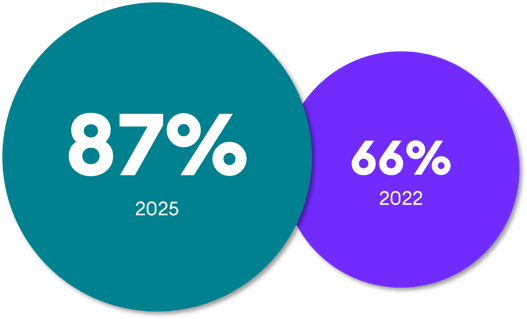
The Hemsley learning surveys reflect a shift ongoing toward more balanced learning journeys, where organisations are curating an intentional mix of virtual, digital, social, and in‑person experiences. The question is no longer ‘virtual or in-person?’ but ‘what combination of components within the blended learning experience delivers the learning outcomes most effectively?'.
As learning portfolios gradually shift to encompass more in-person components, how do you know if you have the right balance? And when should you review and re-balance to achieve the learning outcomes you need?
Learning that is most effective in person:
-
Practical and hands on skills (Springer Nature 2024)
-
Learning that requires real time feedback and adaptive facilitation (American college of education 2025) - such as coaching, management skills, communication
-
Collaborative skills (California Learning Resources Network 2025) - such as teamwork, facilitation, creativity
-
Social-Emotional Skills - (California Learning Resources Network 2025)- such as problem solving, relationship building, negotiation
Learning that can still be very effective virtually:
-
Outcomes focused on knowledge acquisition and comprehension
-
Where learners need the motivation from learning together to engage more fully
-
For topics that have a lower cognitive load, and less behavioural change required
-
Where building a sense of an online learning community is a useful outcome
4. Design Principles: The FACES Framework
To deliver in‑person experiences that feel modern, meaningful, and integrate blended components, programmes can be shaped around the FACES framework:
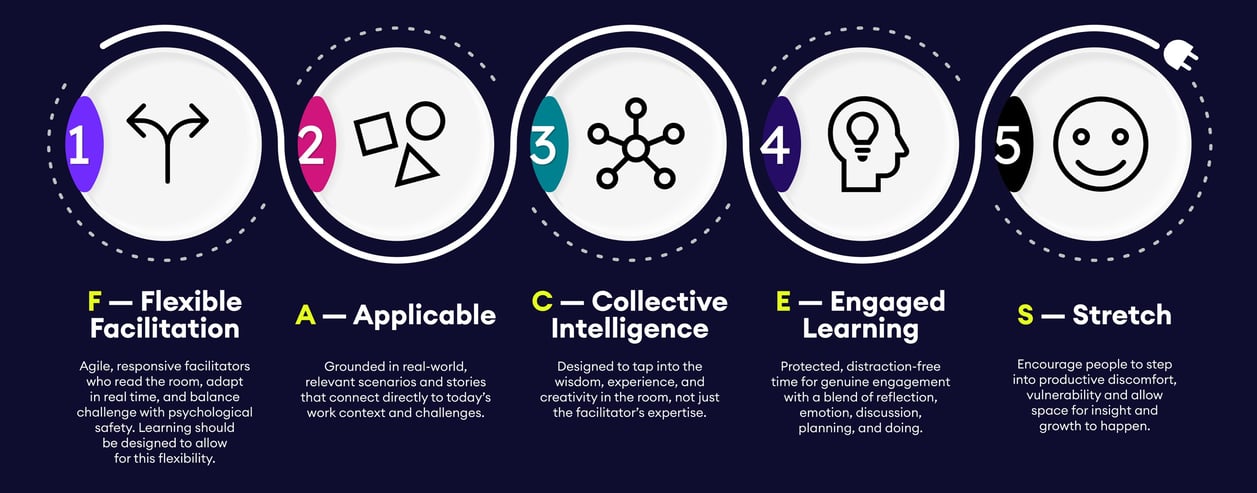
Done well and with intention, these principles create a meaningful human experience that strengthens culture, builds trust, and enhances performance.